Saturday, December 1, 2012

Can a lighter object be accelerated sufficiently to lift a heavier object?

By Ali Pesch

The focus of my second physics news is centered on the question, “can a lighter object be accelerated sufficiently to lift a heavier object?” To attempt to answer this question, I viewed a YouTube video (link below) that depicted the question I am asking. In the video, a string is pulled through a drinking straw and then attached to a small AA battery to one end and 3 batteries to the other end. Holding the straw firmly, the single battery is hurled into rotation, orbiting around the axis of the straw. With increasing speed, the orbital radius increases. At some point, the centrifugal forces exceed the gravitational pull of the 3 AA batteries, and they lift off.


The experiment described above uses the formula a = υ 2 r -1 with “a” signifying acceleration, “υ” representing constant speed, and “r”  being the radius of the circle. In addition, we need to use the equation F = ma, as it follows that the force is the acceleration multiplied by the mass of the battery. The forces in play include the centrifugal pull exerted by the orbiting single battery, that is opposed by the force of tension of the string connected to the weight of the 3 AA batteries attached to the other end. As Newton’s Third Law of Motion suggests, the increasing rotational speed augments the centrifugal vector. At some point, it exceeds the centripetal vector exercised by the 3 AA batteries and these lift off. The force needed to lift off the 3 AA batteries follows Newton's Second Law of Motion F = ma, where “F” stands for force, “m” symbolizes mass and “a” signifies acceleration. In other words, acceleration is produced when a force acts on a mass; heavier objects require more force to move the same distance than lighter objects. The motion in this experiment is not linear but is circular. We are only interested in the force that is necessary to lift the 3 AA batteries up higher into the air. The orbiting battery is being accelerated along a circular path with steady speed while constantly changing its direction tangentially to the orbital circle. Here, the centripetal acceleration is a radial acceleration and can be calculated as ac = υ2 r -1 where “υ” is the constant speed of the object along the circular path and “r” equals the radius of the path. In the experiment, the average weight of a single AA battery is 23 grams (0.023 kg). Below are my calculations:

m1 = 0.023 kg

m2 = 0.069 kg

m2 = 3m1

r = 0.20 m.

Solution

(0.023 kg)(ac) = (0.069 kg)(9.8m/s2)

ac = 29.4 m/s2

ac = υ2 r -1

(.2)(29.4) = υ2

υ = 2.42 m/s


If we want to take it a step further we can find θ.

Solution

Fc = mac

Fg2 = 3Fg1 = Fc

m1ac = m2g

tan(θ) = 3x/1x = 3

tan-1(3) = θ

θ = 71.6o

Alternative

a/g = m2/m1

υ2/ (g)(r) = m2/m1

In this case, the 3 batteries have 3 times the mass of 1 battery, so ac must equal 3g. Overall, a smaller object can accelerate sufficiently to lift a heavier object if the magnitude of the centrifugal acceleration exceeds ag by a factor equal to the factor that the magnitude of the larger mass exceeds the smaller mass by.

This principle is used in commercial applications, such as the centrifugal clutch in vehicle transmissions.

Fg1 = Fg2

θ = tan-1(m2/m1)

http://www.youtube.com/watch?feature=player_embedded&v=DbUU-ueiPUc

Physics of a Spinning Ballerina

By Farah Fouladi

The forces acting on a dancer
- Gravity (downwards)
- Normal Force from the floor (upwards)
- Friction of the floor

Turns in ballet (the physics terms we can use to describe it)
- Angular velocity = how fast the dancer is spinning
- Rotational Moment of Inertia

A fouette is based of the principal of a moment of inertia.
- When the dancer starts turning her arms are brought together
o Small radius
r = 0.2 m
o Small moment of inertia
Treat the dancer’s body as a solid cylinder
Mass of dancer = 55 kg
I = ½ mr2 = ½ (55 kg)(0.2)2 = 1.1 kg m2
o Thus a large angular velocity
Let’s say 1 rad/s
o L = Iw
= (1.1 kg m2)( 1 rad/s) = 1.1 N m s
- The dancer stops for a second and extends her arms and legs
o Larger radius
r = 0.4 m
o Larger moment of inertia
Treat the dancer’s body as a solid cylinder
Mass of dancer = 55 kg
I = ½ mr2 = ½ (55 kg)(0.4)2 = 4.4 kg m2
o Smaller angular velocity
w = L/I
= (1.1 N m s) / (4.4 kg m2)
= 0.25 rad/s
- The dancer continues turning with arms brought together
o Small radius
o Small moment of inertia
o Thus a large angular velocity

How does the dancer stay balanced?
- This is based on canter of gravity!
- Before spin:
o Top half of body is symmetrical
o Vertical center of mass is at center of middle axis
o Legs are not, one leg is straight and the other is in passé

o Xcm = ((xtop)(mtop) + (xrightleg)(mrightleg) + (xleftlef)(mleftleg))/(mtot)
o Xcm = ((0)(29) + (0.2 m)(13 kg) + (- 0.05 m)(13 kg))/(55 kg)
o = 0.04 m shifted to the right!
- After spin:
o Top half of body is symmetrical
o Vertical center of mass is at center of middle axis
o Legs are not, one leg is straight and the other is in fully extended
o Xcm = ((xtop)(mtop) + (xrightleg)(mrightleg) + (xleftlef)(mleftleg))/(mtot)
o Xcm = ((0)(29) + (0.6 m)(13 kg) + (- 0.05 m)(13 kg))/(55 kg)
o = 0.13 m shifted to the right!
So a dancer must constantly adjust to its new center of mass while turning at all
times!!

The effect on a dancer’s body:
- To rotate faster, a dancer must DECREASE her moment of inertia.
- Can do this in 2 ways:
o Decrease mass
o Make sure the bulk of the body is close to the axis of rotation
o See how this correlates to ballerinas needing to very very thin!

Determining the Most Powerful Pokémon

By J.T. Ahearn

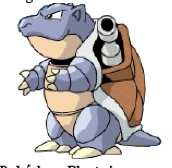
Blastoise:
Height: 5’3”
Weight: 189 lbs

Pokédex: Blastoise can pump out as much water as an Olympic size swimming pool
every minute.

Blastoise emits water from to cannons mounted on its back.

Olympic pool dimensions: 50mx25mx2.0m
Volume=2500m3

Q=vaveA
Cannon diameter: 0.1m
A=π0.05m2x2=0.0157m2
Q-2500m3/60sec=41.7m3/sec
41.7m3/sec=vave(0.0157m2)
vave=2700m/sec

Hydro pump fires approximately 1 liter (0.001m3) of water at the opponent.
m=ρ/V
m=1000kg/m3/0.001m3
m=1kg

v=680m/sec
m=39.5kg

KE=.5mv2
KE=.5(1kg)(2700m/sec)2
KE=3.65x10⁶J

p=mv
p=(1kg)(2700m/sec)
p=2.70x10³W

 
Pidgeot:
Height: 4’11”
Weight: 87 lbs


Pokédex: Pidgeot can fly two times faster than the speed of sound

v=680m/sec
m=39.5kg

KE=.5mv2
KE=.5(39.5kg)(680m/sec)2
KE=9.16x10⁶J

p=mv
p=(39.5kg)(680m/sec)
p=2.69x10⁴W

 
Machamp:
Height: 5’3”
Weight: 287 lbs


Pokédex: Machamp can punch Pokémon to the moon.

ve=escape velocity (velocity necessary to break a planet’s gravitational pull)

ve2=2GM/r

G=universal gravitational constant=6.67×10⁻¹¹ m3/kg s
M=mass of planet
Mearth=5.98x1024kg
r=radius of planet
rearth=6.38x10³km

ve2=(2)(6.67×10⁻¹¹ m3/kg s)(5.98x1024kg)/(6.38x103km)
ve=350,000m/sec

mhuman fist=0.7kg
mhuman=70.0kg
A fists’s mass is approximately 1 percent of organism’s mass
mmachamp=130kg
mmachamp fist=1.30kg

v=350,000m/sec
m=1.30kg

KE=.5mv2
KE=.5(1.30kg)( 350,000m/sec)2
KE=7.96x10¹⁰J

p=mv
p=(1.30kg)( 350,000m/sec)
p=4.55x10⁵W

 
Dragonite:
Height: 7’3”
Weight: 463 lbs


Pokédex: Dragonite can circle globe in 16 hours

rearth=6.38x10³km
C=2πr
Cearth=2π(6.38x10³km)
Cearth=4.00x10⁷km

∆x=vt
4.00x10⁷km=v(57,600 sec)
v=2400m/sec
mdragonite=210kg

KE=.5mv2
KE=(.5)(210kg)(2400m/sec)2
KE=6.05x10⁸J

p=mv
p=(210kg)(2400m/sec)
p=5.00x10⁵W

 
Diglett:
Height: 0’8”
Weight: 2 lbs


Pokédex: Diglet can pull itself underground at the speed of light.

v=3.0x10⁸m/sec
m=0.91kg

KE=.5mv2
KE=.5(0.91kg)(3.0x10⁸m/sec)2
KE=4.12x10¹⁶J

p=mv
p=(0.91kg)(3.0x10⁸m/sec)
p=2.73x10⁸W

The physics of funneling

By Kathryn Taylor
Being college students we have all seen people funneling beers at parties and we all
have that one friend who seems to be able to do it so much faster than everyone else!
The art of funneling is all in the physics.


Funneling all relates to Bernoulli's principle and the movement of fluids.

Using the Bernoulli's equation:

1/2pv^2 + pgh + P = constant

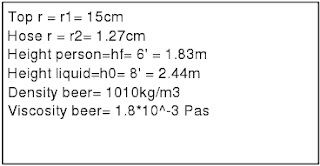
And the stated assumed values I was able to find that the final speed of the liquid was around 4.89m/s. Using this value in the equation of continuity: dV/dt = Av I found that the time taken for a 12oz (0.000355m^3) beer to pass through the funnel would be 0.14s.

We can also use the reynold's number to find out if the flow of the beer would be
turbulent or laminar. I found an RN of 69693 meaning that the flow is definitely turbulent, which is what makes this so difficult to do quickly!

Along with the turbulence there is also a large decrease in the radius of the hose and the persons throat, increasing the velocity, so making it much harder.

Base Jumpin’

By Allie Dyer

Base jumping is an activity where a person jumps off a high structure of
some kind with only a parachute to break their fall. In this video, this Russian base
jumper had some difficulty opening his parachute during this 120 meter fall. http://
www.youtube.com/watch?v=sJ59bNDhJcA
I wanted to know with what force he hit the initial snow and also how far
through the snow he travelled before stopping.

I assumed that it only took about .3 seconds to come to a complete stop from hitting
the initial snow.

V, or velocity, in this problem refers to the terminal velocity of the jumper.
According to the Physics Hypertextbook (http://physics.info/drag/) the typical
skydiver has a terminal velocity of about 55 m/s. This is the velocity needed to
find the force of the impact. But just to make sure I used the Drag Force formula of
Vt=√(2mg/CρA). because I wasn’t sure if this was the same for base jumpers.
For cross sectional area I assumed he was falling on his back/stomach because this
is where most of his injuries occurred so I decided to use a rectangular shape to
determine the cross sectional area of .51 m^2.

Vt=√(2mg/CρA).
Vt=√((2*83.8kg*9.8m/s/s)/(1.0*1.29kg/m^3*.51))
Vt=50. m/s

Using this formula I found a terminal velocity closer to 50m/s. I then could affirm
this velocity by using energy principles (∆KE=-∆PE) to solve for final velocity before
impact.
Vf=√(2gh)
Vf =√(2*9.8 m/s^2*120 m)
Vf=50. m/s.

To find the force with which the man hits the ground, use the equation F= ∆P/∆t
F=0-(83.8kg)(50m/s)/.3s
F=1.4*10^4 N

The Human Slingshot

By Adam Wheeler

The situation I decided to do my physics news on is the Human Sling Shot.
A person is harnessed into the middle of two bungees and secured so that she does
not actually leave the harness when it is pulled back. Then an ATV hooks up to her
via the back of the harness and then takes off in the opposite direction until the
bungees are stretched significantly. Then it is released and the woman begins to fly
forward with a great amount of speed and recoils backwards until coming to a stop.
I decided to try and determine the distance that she would have gone if she was not
connected to the bungee and could actually fire out of the harness.

http://www.youtube.com/watch?v=u2-od4n5Xl0

KNOWNS:

Mass of the woman: 60 kg
K spring constant: 53 N M
Height of the poles connected to the bungee: 30 meters
θ of the bungee with regards to the pole: 20°
woman is 1.5 meters from the ground
she is shot an an angle of 45° with respects to the horizontal
the bungee length is 31m
we assume the bungee is massless


First, I found the length of the bungee cord when she was just hanging there and not
being stretched back.

Cos(20°)= 29m/X

X=29m/Cos(20°)
X=31m

Next I found the PE of the system of the girl plus the two bungees:

PE= 2(1/2* 53N*M * (30m)2) = 48,000 Joules

Therefore,

PE1 = KE2
48,000= .5(60)v2
40m/s= v

Next, we can take this velocity and say that

KE1 = KE2 + ΔPE

48,000= (60)9.8m/s2(-1.5) + .5(60)(vf)2
49,000=.5(60)(vf)2
40.4 = v

Then we find the time it takes the person to land in the y direction

Δy= V0t +.5at2

-1.5= 28t + -4.9t2

-4.9t2 + 28t +1.5=0

Quadratic formula gives: 5.8 seconds

Therefore we can find ΔX from ΔX= X0 + v0t +.5at2

ΔX= V0t
ΔX= Cos(45°)40(5.8)
ΔX=160m

The force the ground exerts on her when she hits the ground is:

F=Δp/Δt. If it takes her .5 seconds to stop then the force is equal to:
F=60(-40.4)/.5
F= -5000Newtons.

Physics of Parkour

 By David Haimes

Parkour is the French art of movement, in which a traceur (someone who does parkour) moves in the most efficient way possible to get from point A to point B. Using our environment as an obstacle course, we use a variety of rolls, climbs, vaults and sometimes flips to traverse varying terrains. Since efficiency is so engrained in the very nature of parkour, the next logical step is clearly to study the physics of parkour to find ways traceurs can more efficiently perform movements and traverse an environment. I will analyze various movements and the related physics to see what patterns emerge and can make me a better traceur.

The roll and the flip – (roll demonstration: http://www.youtube.com/watch?v=5tJAyNxig_A)

A parkour roll is typically used to help lengthen the duration of an impact from jumping from a height. Both the parkour roll and the flip have very similar physics, as they are both rotational movements.

From our circular motion equations, we know the force of rotation is F = mv 2/r.

For a 72.5kg male, who must complete one rotation in order to land successfully, the main thing he can control is his radius by controlling the tightness of his tuck while rotating. A tighter tuck (smaller r) increases the force, allowing him to rotate faster. Using v=rw, estimating a very tight tuck of 2.5ft in diameter (r=.381m), we can approximate that the Force of rotation is mrω 2, or (72.5*.381*π2)=272.6N

The wall run – (http://www.youtube.com/watch?v=2OR6yon8VpQ)

The wall run is used to scale high walls by planting one’s foot and pushing against the wall. Thinking logically, we’ll get a different outcome if the force applied against the wall is at varying angles. If we push directly into the wall, the normal force will counter our force applied, and we will move only horizontally away from the wall, which won’t help us reach the top of the wall. Similarly, if our force applied is only vertical, we will just slip down the surface of the wall and fall down. The optimal angle that gives us both upward movement and prevents us from crashing face-first into the wall is 45 degrees.

This becomes a simple force problem to understand. To not crash into the wall, our Force applied in the x (Fa cos (45)) is equal to the normal force. Furthermore, the forces in the y direction are the force of friction opposing our downward applied force (and so is up), the force applied (Fa sin 45), and the force of gravity caused by our weight. Summing the forces:

Fa cos 45 = Fn

Ffr – Fg – Fa sin 45 = ma

(there is only acceleration in the y)

Plugging in,

µFa cos 45 – mg – Fa sin 45 = m a.
Estimating a coefficient of friction of .8 (we wear very grippy shoes), m = 72.5kg, and a final acceleration of positive 3 m/s2

One last simplification gives us

Fa = m(a+g) / (µcos 45 – sin 45). Using the estimations, we require a Fa of -2153N (down and into the wall) to give us an upward acceleration of 3 m/s2.

In the end, by looking at some physics equations, we can use our intuition and a few calculations to better traverse our environment in a more efficient way by using optimal angles, and tighter tucks in our rotations.