Saturday, October 5, 2019

Underwater Parachutes

I swim for the swim and dive team. The sport of swimming involves physics in ways I had never previously actively thought about in all my years as a swimmer. There are many forces acting on a swimmer’s body when submerged in water. For one, in order to float, there must be an upward buoyancy force that “lifts” the body through its center of mass. And even though a swimmer is floating, the downward force of weight is still present. When the upward buoyant force on a swimmer equals the weight of the swimmer, equilibrium is reached and he/she will be stationary. Swimming, however, especially in a race, is all about forward propulsion. Thus, in order to move forward through the water, swimmers must apply a thrust force with the palms of the hands and forearms as well as with the legs and feet to gain this propulsion. Whenever an object moves through a fluid, there is always a resistive drag force in the opposite direction. Naturally, drag comes from 1) friction between the water and the swimmer’s skin 2) drag due to surface waves, and 3) drag created by pressure when a swimmer pushes the water away. Resistive forces, though seemingly frustrating to deal with, allow swimmers to move forward through the water.


Building muscle and getting stronger is an important part of swimming, as it is for any other sport. Often times, to help my teammates and I build strength, our coach makes us swim laps with a parachute dragging behind us at practice. The parachute is attached to a long string. At the end of the string there is a waistband that buckles in the front. Below is a picture and link to a video for reference. Water gets caught and builds up in the parachute, increasing the force of drag acting against our bodies’ forward movement. Though the parachutes make us swim slower with them on, the increased resistance ultimately helps us get faster in the long-run because we learn to swim with a stronger pull, a more powerful kick, and a more efficient stroke! Immediately after taking the parachute off, you feel stronger and faster as you glide through the water without the additional resistance. So, don’t forget that resistance can be a good thing! Like anything in life, challenge and discomfort makes us better.


Sunday, September 29, 2019

Physics In Ice Hockey

Skating in hockey is really all about physics: more specifically, it's about forces and friction. Because the ice is very slick and has a low coefficient of friction (both static and kinetic), a hockey player cannot accelerate by simply pushing backward with their foot, like we do when we walk (where the friction is greater and allows the ground to push us forward when we push on it). In order to generate force and accelerate forward, a hockey player must instead push off at an angle perpendicular (or as close to 90 degrees as possible) to the location they want to go. By angling their ankle and skate blade closer to the ice, they are able to dig into and push off the ice (supply a force into the ice), which subsequently generates a force that is perpendicular to their foot and is in the opposite direction of the force the skater exerts. This is the normal force that the ice supplies. By increasing the angle to 90 degrees (pushing off perpendicular to where they wish to go), they can ensure that most or all of the force generated is in the direction they want to go; this works because normal force is always perpendicular to the ground or surface that receives the applied force, which in this case is the force of the skater pushing their foot and skate blade into the ice.

Physics in Volleyball

Yesterday I went to the women's volleyball game against Loyola. As the game went on I began to think more and more about how gravity and forces play significant roles in this sport. When someone is getting ready to serve, they throw the ball upwards (exerting an upward force) and then their palm makes contact with the side of the ball in the air (exerting yet another force, but this time in the forward direction and partially downwards depending on if the serve has top spin or if it is simply a float serve). Due to gravity, the ball's height will decrease as it reaches the other side of the net. Depending on the magnitude of the force exerted on the ball by the server, the ball could accelerate downwards much more quickly than expected, which makes the ball more difficult to pass for the receiving team. When the passers forearms come in contact with the ball, there is both and upward and a forward force at some angle theta so that the ball will appropriately travel into the hands of the setter. Once the ball reaches the setter, there is a very brief moment in which the setter allows the ball (being acted on by the force of gravity) to sink into her hands so that she may exert a strong upward and forward force to set the ball for one of the hitters. The greatest force exerted by any player in the game is when a hitter goes to hit the ball over the net in order to try and get a kill, and ultimately, a point. When a hitter is hitting, they attempt to exert as much of a downward force as possible. This downward force is always accompanied by some sort of forward force so as to avoid directly hitting the ball into the net. While the hitters are exerting this great downward force, gravity is also working in their favor in the same downward direction. The velocity and acceleration of the ball constantly changes throughout the game as passes decrease the velocity and overall acceleration of the ball and hits increase the velocity and acceleration of the ball. When velocity and acceleration increase as a result of a force exerted by a hitter it is much more difficult for the receiving team to react quickly enough to pass the ball and retaliate in a similar manner.

Saturday, January 6, 2018

Physics of karate

Even though I have never done karate myself, in the past I have seen many karate videos of people breaking concrete bricks and wooden boards with their bare hands. Looking at a basic principle of physics helps to understand how people can pull off these impressive moves.
Since F=ma and Momentum = mass x velocity, force and mass are positively related. When trying to break a board, force needs to be transferred as fast as possible and the person also has to use as much of his or her body mass in the motion as possible.
In addition, the extension of a person’s arm is crucial to breaking the board. Since momentum and velocity are also positively related, the extension point at which the person’s hand hits the board must maximize velocity. Therefore, his or her arm must not be fully extended. Rather, it should be at a point of extension in which the hand has a positive or zero acceleration.
Finally, the person must attempt to exert as much force per square inch on the board as possible in order to break it. That is why hitting the board with the side of the hand is much more effective than hitting it with the palm.
By using the side of the hand, learning to efficiently channel body mass, and finding the optimal point of arm extension, one can plausibly break a board with lots of practice.
Source:

Friday, January 5, 2018

Ice vs. Field Hockey

Having played field hockey for much of my life, I never really thought about why field hockey sticks are so stiff compared to ice hockey sticks and what implication this has on shooting in both sports. The fundamentals of physics suggest that the ball velocity of a field hockey shot is created slightly differently than the puck velocity of an ice hockey shot.
Since field hockey sticks are so hard and stiff, the stick is minimally flexed before it makes contact with the ball. When hit, a field hockey ball gains its velocity predominantly by the kinetic energy created as the player accelerates the stick. A large force is exerted on the ball and momentum is transferred from the stick to the ball.
However, in ice hockey, the puck velocity on a shot is created through kinetic energy and elastic potential energy. While the puck gains velocity through kinetic energy in a similar mechanism as a field hockey ball, a puck gains additional velocity through the release of potential energy that is stored when the hockey stick is flexed against the ice. The momentum created by the velocity of the moving hockey stick and the release of the stick flex is transferred from the stick to the puck and determines the velocity of an ice hockey shot.
Another reason why ice hockey is a much faster paced sport is because of the friction involved. Field hockey is commonly played on grass turf, which, compared to ice, is much rougher. Assuming hockey pucks and field hockey balls are made of the same type of plastic, the coefficient of friction for the between the turf and ball is much greater than that between the ice and puck. Thus, if one was the apply the same amount of force to both the puck and ball, the puck would travel much farther. This is why the field hockey turf is watered at the beginning of the game and a halftime, as water helps to reduce the friction between the ball and turf.

Wednesday, December 13, 2017

Thermal Equilibrium


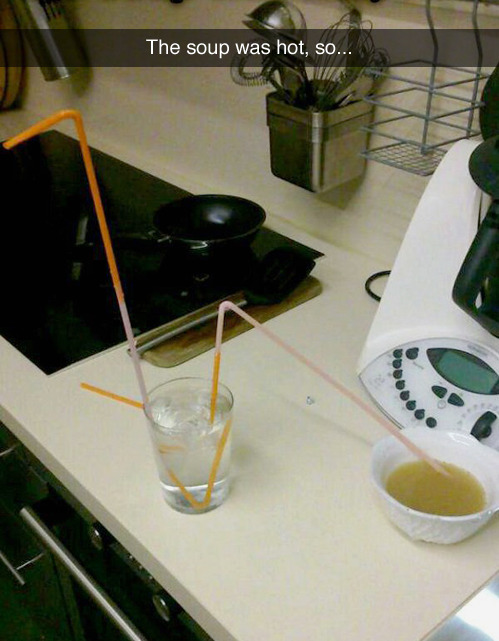
After seeing this picture, my friend texted me asking if we could try this, so we set up our own using hot coffee, a glass of ice water, and straws.
The principle it's based upon is thermal equilibrium, but I didn't think the ice water would be enough to actually cool the coffee a significant amount since it moved so quickly through the strawIt did actually work.

Theoretically, the calculations for the thermal equilibrium equation would be as follows:

Assuming there is approximately one straw full of coffee in the ice water, and the average drinking straw has a length of around 8 inches and a diameter of 0.21 inches, the volume of the coffee inside the straw will be 4.541x10(^-6) m³. Since coffee is very similar to water, we can use the conversion 1 m³ of water = 1000.0 kg of water, giving us a mass of .0045 kg of coffee in the straw. Since we got the coffee fresh, and most coffee is served at about 180°F, we convert that to 82.2°C. 

The straw only takes up 4.541x10(^-6) m³ in the water, so it won't interact with the entirety of the cup of water. Using double the volume of water displaced by the straw, to represent the volume surrounding the straw that might have a chance of interacting with the coffee in the straw in such a short amount of time, gives us .009 kg in the cup at freezing

So Qʷᵃᵗᵉʳ+Qᶜᵒᶠᶠᵉᵉ = 0J
Because we use water for both of them, specific heat (c) can be cancelled out.

(.0045kg)(cwater)(Tᶠ - 82.2) + (.009kg)(cwater)(Tᶠ - 0) = 0J
.0045Tᶠ - .3699 + .009Tᶠ = 0J
.0135Tᶠ = .3699
Tᶠ = 27.4°C


Ice cream heat transfer

The other day, I set out a gallon of ice cream so it could thaw enough for me to actually be able to scoop some out with a plastic fork, because I am a lazy college student who doesn't want to do the dishes. In considering what this melting entails, I thought about heat transfer.

In order for the ice cream to melt, heat is is absorbed. Enough heat needs to be absorbed to first melt the ice cream, Lf for ice cream, and then heat continues to absorb so that the ice cream can reach thermal equilibrium with its surroundings. Obviously, no one wants to eat room temperature ice cream. Therefore, the ideal situation is to scoop the ice cream before it can absorb enough heat to completely melt. The energy being transferred to melt the ice cream comes from the surroundings such as the counter or air. It also explains why people will run an ice cream scooper under hot water prior to scooping. The warm scooper provides energy necessary to melt the ice cream, and make it easier to scoop. Therefore, it's unfortunate I am a broke college student and don't own an ice cream scooper.

Unfortunately, I didn't have a scale to weigh the half empty ice cream container, but the heat of fusion for vanilla ice cream is about 204kj/kg, meaning it's okay if you forget about the ice cream for a few minutes, as it takes quite a bit of energy to melt. According to the internet, it takes more energy to melt vanilla ice cream than chocolate or strawberry. I don't really have an explanation for this, but just thought it was an interesting reasoning for next time your friend's chocolate ice cream is melting faster than your vanilla.