One of the things that most of us have to do every day is make our way up Colgate’s hill. It is a somewhat strenuous endeavor, and since I like to bike to class it has become a bit of a hassle. However, what makes it worth it to me is the thrill of the ride down. As gravity takes the reigns, you are sent speeding down the twisting roads of campus, all the way until you reach the bottom at James C. Colgate Hall. Ever since I started taking physics, I have always wondered: “What if I threw caution to the wind and never braked during my descent? How fast would I truly be going and how many injuries would I get if I fell?” So after discovering this outlet to share my findings, I started my journey to figure out the speed I could theoretically obtain on this otherwise mundane drive down a regular old hill.
The first idea that came to mind when I was pondering over the aforementioned questions was a simple one. Just time yourself going down the hill, and never use the brakes. Then just use the kinematic equation vf=v0+at. With a= 9.8m/s2 and V0= 0 m/s, then plugging in time to figure out the final velocity. However, there lies a single brutal flaw in this plan, I, like many physicists, value my safety and do not want to become a red smear on the road. So, I pivoted to the much safer and mathematically strenuous idea of using forces to calculate the final velocity.
The first thing I did was set up a situation and gather the data needed for the calculations. Using Google Maps, I found that the highest point on campus that had the data I needed was the Coop, and the lowest point at the end of the hill was James C. Colgate Hall. So I created the route and found the distance and height of the trip. Shown below.

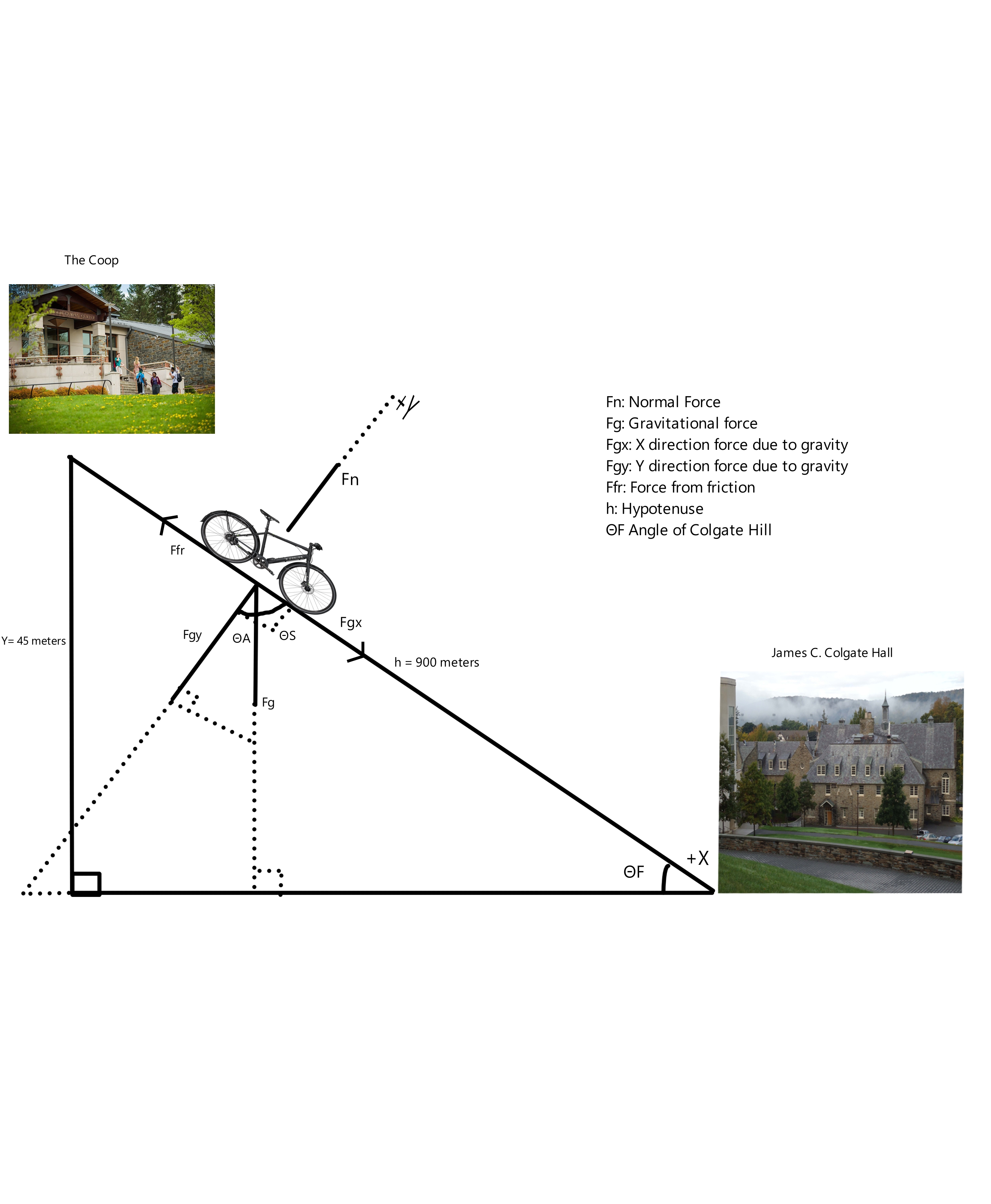
We can use trigonometry to find some values, mainly ΘF, ΘS, Fgx and Fgy.

We also know that Fg=mg, therefore we can make the equations
Fgx=mgsinΘF
Fgy=mgcosΘA
We can also find ΘA since ΘA and ΘS make a 90º angle, which makes ΘA=2.87º. Notice how it is the same as ΘF, this is true for all problems like this.
We can assume that Fn will have the same magnitude as Fgy thanks to Newton’s third law(Every action has an equal and opposite reaction), just in the opposite direction.
Therefore:
Fn=-Fgy.
We can calculate all of these forces right now, but to simplify things later, we will refrain from doing so.
The only force that is left to calculate is Ffr, which according to our textbook is:
Fgx-µkFn=Fr
Unfortunately, µk for my bike is different than the gravitational constant given in our textbook for rubber on asphalt because my bike uses wheels, which are affected by rolling friction. After much research into rolling friction or rolling resistance, I have decided to spare you the details, and instead, use a coefficient found online for bike tires on asphalt(0.004)1.
We can then calculate my bike’s acceleration using the simple equation:
Fgx-Ffr=max.
By plugging in all our knowns we are left with the formula:
mgsinΘF-µk(mgcosΘA)=max
Since every part of the equation has mass(m) in it, we can cancel out mass and get this equation, which is why I refrained from calculating anything earlier.
gsinΘF-µk(gcosΘA)=ax
Plugging in our values with ΘF and ΘA =2.87º and µk=0.004. We get an acceleration of
0.45m/s2!
This at first glance seems a bit small, but consider that this is over a 900meter distance, and we can use the kinetic equation Vf2=V02+2a(Δx).
Assuming an initial velocity of 0, we get a final velocity of
28.5m/s!
For reference, 28.5m/s is equivalent to 63.7 mph!
63.7mph is something you would be more likely to see on a major freeway, not from some random hill on a college campus, and a fall from that speed would leave you with more than just a scratch.
So if you were to take anything from this Physics journey, Make sure you keep your brakes in top condition and wear a helmet!
