Sunday, September 4, 2011

Extreme 2010 Weather Pattern Explained by Physics

Hello all,

The site that I used to find my physics news article was Science Daily. On this site I found and interesting article about an extreme weather pattern that occurred in July of 2010 and has now been explained by physics.

The article explains how the heat wave and drought experienced in Russia in 2010 was also connected to the severe flooding and monsoons that occurred in Pakistan that same year. A stagnant weather pattern called an Omega blocking event developed over a high-pressure ridge above western Russia. This blocking event, which divided the jet stream, had the effect of slowing the Rossby wave and prevented the normal progression of weather systems from west to east. As Earth spins on its axis Rossby waves meander around the globe in a westerly direction. Currents in the center of these waves form the jet streams, fast-moving columns of air that push weather systems from west to east. The event caused high pressure to form over Russia and trap a hot, dry air mass. As the high lingered, the land surface dried and the normal transfer of moisture from the soil to the atmosphere slowed. The blocking pattern also created unusual downstream wind patterns over Pakistan. Areas of low pressure on the leading edge of the Rossby wave formed in response to the high that pulled cold, dry Siberian air into lower latitudes. The shift led to heavy monsoon rains over the northern part of Pakistan.

Overall, the physical interactions of the Coriolis effect and pressure gradients are responsible for our weather patterns. Slight deviations from the normal Rossby waves can have large impacts on the regional weather we experience.


Hope you all enjoyed the presentation,
Stephen La Rosa

Top Gear Physics

So my example of physics in everyday life comes from one of my favorite television shows, Top Gear from the BBC. Basically the show follows the antics of three British car lovers who test and review cars ranging from economical family vehicles all the way up to the ultimate in super cars. Now any car could be used as a physics example for a number of concepts such as momentum, acceleration, different forces and so on.

However, a notable example of how different forces can affect the car comes from when the Top Gear team tested the Swedish Koenigsegg super car. When these amazing machines are engineered they have to contend with a variety of challenges including how they handle sources of friction, the mass of the car, and the power the car produces. In the case of the Koenigsegg, the engineers created a machine with a massive amount of horsepower and a top speed above 200mph. However, when Top Gear tested the car they noted that its light weight, massive horsepower, and lack of a rear spoil created a car that was immensely difficult to handle and which struggled to apply all of that power to the road effectively. In fact, during one of their attempts to test the car it resulted in a wreck.


After seeing the results of that test and given the cars potential, the Swedish designer took back the car and made some critical changes, including the addition of a rear spoiler. The goal of this addition was to increase friction between the car and the air which would result in increased grip between the car and the road surface. The Top Gear crew's second attempt at testing this car resulted in the show's best test track time up to that point. It has since been passed by other cars but it is very cool how applying certain ideas, which we are going to learn about in this course, resulted in such an amazing machine.


Saturday, September 3, 2011

Earthquakes - Virginia's 2011 quake


Here's the government's official public report of the quake in case anyone wants the specifics http://earthquake.usgs.gov/earthquakes/recenteqsww/Quakes/se082311a.php#summary.  My presentation was more for earthquakes in general.

We all know that the tectonic plates are constantly shifting. This is essentially the reason earthquakes occur. As the plates shift, they bend, stretch and compress against one another, causing a buildup of potential energy. When this potential energy becomes great enough, it overcomes the force of static friction between plates, and they slip against one another, creating millions of tons of force as the plates grind against each other; essentially converting potential energy to kinetic energy. This kinetic energy is released as radiated energy (seismic waves), fracture energy (ruptures), and thermal energy (heat).
Physics helps us to understand the destructive forces behind the seismic waves. These waves come in two forms; Body Waves and Surface Waves, each with two subtypes.
Body waves resonate through the interior of the earth and are quicker and shorter-lived than surface waves. The two subtypes are P-waves (primary) and S-waves (secondary). P-waves are compression waves (like sound waves) that compress and extend the rock mass in the direction it travels (through both solids and liquids). S-waves are shear waves. Their motion is perpendicular to the direction of travel, and thus are the ground-shaking waves (cannot travel through water however).
Surface waves are slower moving, but longer lasting waves, and more damaging due to their location and unique properties of the waves. The two subtypes are Love waves and Rayleigh waves. Love waves are like S-waves put on their sides, moving the ground from side to side in a horizontal plane (solids only), while Rayleigh waves move vertically and horizontally in a vertical plane (solids and liquids).
It's important to note that these waves are unpredictable because they travel at different rates through different substances, and are reflected/refracted at the interface between rock types. Thus they readily change direction and properties (P-waves can convert to S-waves for instance). - post written by John Kahler

Friday, September 2, 2011

The Earth May Have Had 2 Moons!!!


Hello everyone!

So, firstly, I'd like to share the Nature News Blog with you all. It has little blurbs about cool things that are happening in the world of science and is definitely a neat resource to check out.

On that blog, I found this article about discrepancies in dating of various samples of the Moon's crust.

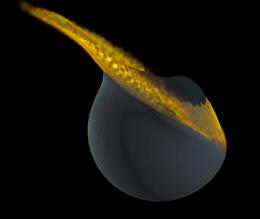
More interestingly, that article finally lead me to the article I presented about the new proposed theory about our Moon. The article explains the model in which the early Earth may have had 2 moons initially. Our Moon formed when a Mars-sized object collided with the Earth. However, this model suggests that another small body was in a gravitationally stable point in the Earth-Moon system. This body was approximately 1/30th of the Moon's mass. Since the 2 bodies were in the same orbit, they ended up merging (into what is now our lone Moon) in a slow motion collision (which took several hours to complete). The other small body basically collided and splat onto our Moon, spreading out like a pancake. This model would account for the differing terrains on the side of the moon that we see and on the farside.

I'm not sure of all the detailed Physics that were employed in arriving at this model, but hopefully we'll all learn at least a bit of them in class!!

The picture included in this post is from the article.