This weekend I flew down to Washington D.C.. Given my dislike of flying I was not thrilled when I saw the tiny plane I was flying down in. For some reason, big planes always seemed safer than small planes. Something about the small planes always made me wonder how they are able to stay in the air given how small the engines are. Given our recent discussion of momentum, I figured I could use that information to show that the size of the plane is more or less irrelevant. A small plane is considered 12,500 lbs or less and a large plane (ex Boeing 747) weighs 735,000 lbs. Momentum (p)= mv and given momentum in a system is conserved, the mgasvgas=mplanevplane. So although the small plane (12,500 lbs → 56.7 x10^5 g) is lighter it also then requires the engine to shoot out less gas or gas at a lower velocity, to reach the necessary take off speed of ~250km/hr). Meanwhile, the Boeing 747 (735,000 lbs → 33.3 x10^7g) requires more gas leaving the plane at a higher velocity to reach the same take off speed of ~250km/hr. 250km/hr *(1hr/3600sec)*(1000m/1km) = 69m/sec. Therefore, the small plane requires a momentum of (56.7x10^5g)(69m/sec) = 391,230,000 gm/sec. The large plane requires (33.3 x10^7g)(69m/sec) = 22,977,000,000 gm/sec which is more than 50 times the amount of momentum. So now it makes a bit more sense why some of the engines on large planes like the Boeing747 may be the same size as some of these tiny planes, but that’s just to make up for the larger mass and that each size plane would be equally as safe and should be able to safely take off!
Tuesday, October 15, 2019

Monday, October 14, 2019
Case Library Hill
The physical act of walking requires the presence of friction. You need the force of friction between your shoes and the ground to point in the opposite direction of your motion in order to push off of your toes and move forwards.
At Colgate, no matter where you are going, you are almost always walking up a hill or down a hill. In both scenarios, friction is paramount in getting you where you need to go without sliding. Almost every day, I make the long, arduous trek down to Case Library. I usually walk from my dorm, so most of the walk is downhill. Due to the indirect set up of the path that leads to the library, many people decide to cut through the grass to go down the hill, ignoring the paved walkway. While it is faster to walk through the grass, it is more dangerous due to the risk of falling and then sliding or rolling down the hill. As seen in Engineering Analysis of Vehicular Accidents, written by Randall K. Noon, the coefficient of friction for wet grass, 0.20, is much smaller than the coefficient of friction for wet concrete, 0.60. On an angle, the force of friction is equal to μmgsinθ where θ is the angle of the incline or decline. When μ is a small value, as is seen in the case of wet grass, the magnitude of the force of friction is smaller, increasing the likelihood of slipping and falling forwards down the hill.
At Colgate, no matter where you are going, you are almost always walking up a hill or down a hill. In both scenarios, friction is paramount in getting you where you need to go without sliding. Almost every day, I make the long, arduous trek down to Case Library. I usually walk from my dorm, so most of the walk is downhill. Due to the indirect set up of the path that leads to the library, many people decide to cut through the grass to go down the hill, ignoring the paved walkway. While it is faster to walk through the grass, it is more dangerous due to the risk of falling and then sliding or rolling down the hill. As seen in Engineering Analysis of Vehicular Accidents, written by Randall K. Noon, the coefficient of friction for wet grass, 0.20, is much smaller than the coefficient of friction for wet concrete, 0.60. On an angle, the force of friction is equal to μmgsinθ where θ is the angle of the incline or decline. When μ is a small value, as is seen in the case of wet grass, the magnitude of the force of friction is smaller, increasing the likelihood of slipping and falling forwards down the hill.

A smaller μ is not the only threat posed when descending the grassy hill to get to the library. It is also important to be cautious about the route you take down the grassy hill. You should not take a very steep route because it will also increase your chances of slipping. The x-componenet of the force of gravity is equal to mgsinθ. As θ increases, there is an increase in both the component of the force of gravity that is parallel to the incline and your chances of slipping.
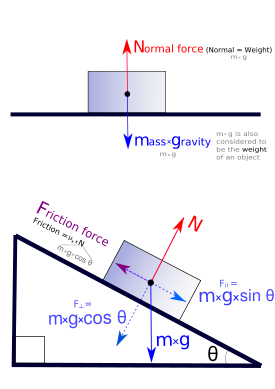
While it may appear faster and easier to cut through the grass to get to the library, this route should only be taken with great caution and on a day when the grass is not wet.
Sources: https://saferroadsconference.com/wp-content/uploads/2016/05/Peter-Cenek-Frictional-Characteristics-Roadside-Grass-Types.pdf
http://thecraftycanvas.com/library/finding-forces-acting-upon-objects-on-an-inclined-plane-or-ramp-with-free-body-diagrams/
Friday, October 11, 2019
Physics and Gymnastics
Gymnastics is by far my favorite sport to watch. This week, I've probably watched at least 10 youtube videos from different meets. Simone Biles - the most decorated gymnast of all time and the breaker of many records - is my favorite gymnast. The other day, as I watched her do the Biles on vault, floor, and beam, I started to think about how she is able to fit so many skills into one move. Just for some perspective, the Biles on floor is a double backflip with 3 twists - she is the only person who can do this. Looking into this has shown me that it's a little complicated and involves things we haven't learned. However, there are a lot of other places in gymnastics we can apply simple physics concepts. 1. It takes a lot of momentum to get up in the air to a velocity that allows for all the turns and twists to happen. 2. The normal force is greater than mg when a gymnast is going up. 3. THERE'S A LOT OF PROJECTILE MOTION INVOLVED (take a peek at the images down below!).
3. At the very top of motion on the uneven bars, potential energy is converted into kinetic energy.
4. When the gymnast dismounts and lands, the feet exert a lot of force on the mat - but the mat exerts it back - which is why the gymnast is able to stop moving. Watching Simone Biles, it's hard to believe that what she's dong isn't magic, but through the power of physics, we can actually see that it's all just science.


3. At the very top of motion on the uneven bars, potential energy is converted into kinetic energy.
4. When the gymnast dismounts and lands, the feet exert a lot of force on the mat - but the mat exerts it back - which is why the gymnast is able to stop moving. Watching Simone Biles, it's hard to believe that what she's dong isn't magic, but through the power of physics, we can actually see that it's all just science.


Physics of Tennis Ball(istic)s
This year, I started playing club tennis. There is much to be said about the physics of tennis, but this blog post will be focused on the ballistics, or projectile motion, observed in the sport.
Generally, ballistics is reserved to the study of projectiles from ranged weapons. While Colgate does not own a ball launcher (which would benefit this blog post as well as my nascent tennis skills), I do have an experienced tennis player friend who shall replace the ball launcher and act as my "ranged weapon".
For the purposes of this blog post, let us assume the trajectory of a tennis ball follows a smooth arc across the court. The forces that we consider are gravity, which is constant throughout the ball's air time, and the initial force from the "ranged weapon". Kinematics tells us that when the ball reaches it's peak, it shifts from a positive y velocity to a negative y velocity and maintains a constant x velocity throughout the travel time. The physics behind a tennis ball's motion is actually much more complicated when taking into account air resistance and spin on the ball. The momentum and collision unit that we just started adds yet another degree of complexity as we can now study the physics of the ball bouncing off the racquet.

Generally, ballistics is reserved to the study of projectiles from ranged weapons. While Colgate does not own a ball launcher (which would benefit this blog post as well as my nascent tennis skills), I do have an experienced tennis player friend who shall replace the ball launcher and act as my "ranged weapon".
For the purposes of this blog post, let us assume the trajectory of a tennis ball follows a smooth arc across the court. The forces that we consider are gravity, which is constant throughout the ball's air time, and the initial force from the "ranged weapon". Kinematics tells us that when the ball reaches it's peak, it shifts from a positive y velocity to a negative y velocity and maintains a constant x velocity throughout the travel time. The physics behind a tennis ball's motion is actually much more complicated when taking into account air resistance and spin on the ball. The momentum and collision unit that we just started adds yet another degree of complexity as we can now study the physics of the ball bouncing off the racquet.
Sunday, October 6, 2019
Bendddddddddd, and hopefully not snap
Rowing has been around for centuries. While it originated as a form of punishment, it has developed into a very competitive sport perfect for the tall and vertically challenged. Similar to everything in life, physics is very important to rowing. Part of being a competitive team is understanding the physics of rowing and how to use physics to make your boat go faster.
In a boat there can be 1, 2, 3, 4, 5, or 9 people together in a row. The rowers work to make the boat go faster by using their oars. The blades at the end of the oars go into the water and are used to propel the boat forward. In each stroke Newton's law is applied between the blade and the water. The blade applies a force onto the water to push the water towards the back of the boat and to also move the boat forward. The water applies an equal and opposite force onto the blade, pushing the blade towards the front of the boat and resisting the movement of the blade through the water. This interaction can be easily visualized by the oar shaft. The shaft of the oar is not in the water, and can bend during the stroke. The force of the water on the blade creates this bend. The bend of the oar creates a tension force which also helps propel the boat forward.
In a boat there can be 1, 2, 3, 4, 5, or 9 people together in a row. The rowers work to make the boat go faster by using their oars. The blades at the end of the oars go into the water and are used to propel the boat forward. In each stroke Newton's law is applied between the blade and the water. The blade applies a force onto the water to push the water towards the back of the boat and to also move the boat forward. The water applies an equal and opposite force onto the blade, pushing the blade towards the front of the boat and resisting the movement of the blade through the water. This interaction can be easily visualized by the oar shaft. The shaft of the oar is not in the water, and can bend during the stroke. The force of the water on the blade creates this bend. The bend of the oar creates a tension force which also helps propel the boat forward.
 |
| Image 1: The rower faces the back of the boat, so in this photo the front (bow) is to the left and the back (stern) is to the right. |
As a coxswain I am in charge of steering the boat while also providing technical feedback and motivation during practices and races. Steering the boat is much different from steering a car. Each boat has a rudder which consists of a stationary fin and a small usually rectangular fin that can move with a string. The direction the rudder moves dictates which way the boat will turn. The rudder can either be very quick to turn or very slow, and sometimes it can depend on who's in the boat. If you put eight lightweight men into an eight and turn the rudder a certain amount, the acceleration of the turn will be quicker as compared to a boat full of heavyweight men. This is indicative of the formula for force: F=ma. Since force is constant and mass is changing, the acceleration has a negative correlation to the mass. Using the rudder is great but it creates drag, which slows us down. So how do I steer without using the one steering mechanism I have? I have the rowers help me out. Increasing pressure on one side of the boat acts as a type of force to push the boat to the opposite side. Thus I can use my rowers to help me get a point without slowing us down with the rudder.
 |
| Image 2: This is what an 8 person boat looks like. All the rowers face the back and the coxswain (me) faces the front. This is what Lake Moraine looks like at 6am practice. |
Saturday, October 5, 2019
Sprinter acceleration phase
During practices, my coach would often remind us to strike directly down onto the ground when accelerating. He emphasizes lauching out horizontally while while striking down vertically. When I thought about how the vectors would look for these forces, I realized you end up with a diagnol line facing away from the finish line. I now see that the ground pushes back on the runner with an equal amount of force. The more force exerted onto the ground by the runner, the more distance is covered with each step. Ignoring air resistance, muscle fatigue, and assuming ideal conditions, a runner who can strike the ground with a constant force will have an increasing velocity because of a constant acceleration. This made me think about the phrase, "the one who slows down the least, wins". It can also be said that the sprinter who can keep applying their maximum force for the longest interval of time will be victorious.
Underwater Parachutes
I swim for the swim and dive team. The sport of swimming involves physics in ways I had never previously actively thought about in all my years as a swimmer. There are many forces acting on a swimmer’s body when submerged in water. For one, in order to float, there must be an upward buoyancy force that “lifts” the body through its center of mass. And even though a swimmer is floating, the downward force of weight is still present. When the upward buoyant force on a swimmer equals the weight of the swimmer, equilibrium is reached and he/she will be stationary. Swimming, however, especially in a race, is all about forward propulsion. Thus, in order to move forward through the water, swimmers must apply a thrust force with the palms of the hands and forearms as well as with the legs and feet to gain this propulsion. Whenever an object moves through a fluid, there is always a resistive drag force in the opposite direction. Naturally, drag comes from 1) friction between the water and the swimmer’s skin 2) drag due to surface waves, and 3) drag created by pressure when a swimmer pushes the water away. Resistive forces, though seemingly frustrating to deal with, allow swimmers to move forward through the water.

Building muscle and getting stronger is an important part of swimming, as it is for any other sport. Often times, to help my teammates and I build strength, our coach makes us swim laps with a parachute dragging behind us at practice. The parachute is attached to a long string. At the end of the string there is a waistband that buckles in the front. Below is a picture and link to a video for reference. Water gets caught and builds up in the parachute, increasing the force of drag acting against our bodies’ forward movement. Though the parachutes make us swim slower with them on, the increased resistance ultimately helps us get faster in the long-run because we learn to swim with a stronger pull, a more powerful kick, and a more efficient stroke! Immediately after taking the parachute off, you feel stronger and faster as you glide through the water without the additional resistance. So, don’t forget that resistance can be a good thing! Like anything in life, challenge and discomfort makes us better.


Building muscle and getting stronger is an important part of swimming, as it is for any other sport. Often times, to help my teammates and I build strength, our coach makes us swim laps with a parachute dragging behind us at practice. The parachute is attached to a long string. At the end of the string there is a waistband that buckles in the front. Below is a picture and link to a video for reference. Water gets caught and builds up in the parachute, increasing the force of drag acting against our bodies’ forward movement. Though the parachutes make us swim slower with them on, the increased resistance ultimately helps us get faster in the long-run because we learn to swim with a stronger pull, a more powerful kick, and a more efficient stroke! Immediately after taking the parachute off, you feel stronger and faster as you glide through the water without the additional resistance. So, don’t forget that resistance can be a good thing! Like anything in life, challenge and discomfort makes us better.
Subscribe to:
Posts (Atom)