On Tuesday, I went to Dr. Alix Deymier's talk. Dr. Deymier is an assistant professor at the Biomedical Engineering at UConn's School of Medicine studying bone formation and its relationship to acidosis. Dr. Deymier has had an interesting career path. She wanted to study the material composition of Native American Art and what makes up unique pottery, but instead she was forced to study bone bio-mechanics at Northwestern. Having little to no background in biology, she spent her graduate career learning about X-ray diffraction in bone, including the relationship between collagen and minerals and outside factors that affect their structure and function. Ultimately, she chose bones over art.
Her research on acidosis is incredibly fascinating and admittedly terrifying. Her lab wanted to analyze the effects of chronic soda intake on bone health. The main reason why she wanted to look at these effects is that bones are a large bicarbonate sink. Bicarbonate formation plays a role in chronic kidney disease and in the Keto diet; and bicarbonate reacts with acid to form a buffer solution. She took a group of mice and fed them homemade soda comprised of ammonium chloride in aqueous solution with a sprinkling of sugar (this was done because you cannot legally use soda in the lab since its pH is too low). In only 24 hours of drinking the homemade brew, the mice's blood and urine pH had dropped, their bone mineral and bone carbonate content had dropped, fraction resistance had increased, but there were no cellular changes within the bone. This meant that the soda's acidity alone had reacted with the bones to remove carbonate ions from the bone and made them weaker. What's even more shocking is that the pH of her homemade soda is less acidic than that compared to normal soda (Pepsi and Coke had pH values of around 2.5)! I thought this study was incredibly fascinating because it was interesting to see the interactions between chemistry, physics, and biology. Physics comes into play with her research because she wanted to look at the physical properties of bone to see how it changes with the soda solution. I learned something very important from her talk: drink less soda!
Professor Bradley T. Christian is a professor of Medical Physics and Psychiatry and the Director of PET Physics at Waisman Brain Imaging Lab at the University of Wisconsin-Madison School of Medicine and Public Health. He received his B.S. in 1989 in physics at St. John’s University. He proceeded to get a M.S. in 1991 and his Ph.D. in 1994, both in Medical Physics at the University of Wisconsin-Madison. His current research focuses on using PET radiotracers to study brain chemistry. He focuses on Alzheimer's disease, and investigates brain pathways involving dopamine, serotonin, and other neurochemical systems.
Recently, Professor Christian used positron emission tomography to assess memory in patients with Down syndrome. He performed a variety of scans to identify a variety of markers in the brain such as Aβ and tau to figure out if the tau PET biomarker is related to early memory impairment. He found that tau was negatively associated with memory in Aβ+ groups but not in Aβ- groups. This finding is similar to Alzheimer's disease where high tau indicated dementia in Down syndrome.
References:
https://www.ncbi.nlm.nih.gov/pmc/articles/PMC8976157/pdf/DAD2-14-e12256.pdf
https://www.medphysics.wisc.edu/blog/staff/christian-bradley-t/

Angela M. Gronenborn is a biophysicist researching HIV pathogenesis as the Rosalind Franklin Chair at the University of Pittsburgh Medical Center, in addition to her role as a Distinguished Professor in the Department of Structural Biology. Dr. Gronenborn traces her roots far from Pittsburgh, to Cologne, Germany, where she completed her education from primary school to PhD. Prior to beginning her undergraduate studies in physics and biology at the University of Cologne, she intended to study mathematics but was dissuaded by both her father and her high school principal despite her excellence in the subject. Because she did not ultimately want to use a degree in mathematics to become a teacher, she would not have been able to earn a living as a mathematician due to her gender. After receiving her bachelor's degree in 1972, Gronenborn pursued a master's degree in chemistry, which she received in 1975. Her PhD studies focused on comparing coupling constants of aromatic N-oxides that were experimentally derived using 13C Nuclear Magnetic Resonance (NMR) spectroscopy to those calculated via quantum mechanics (Kramer, 2008).
Dr. Gronenborn was accepted into a Postdoc program away from Cologne at the National Institute for Medical Research (NIMR) with the Medical Research Council located in London, where she aimed to solve the structures of protein-DNA complexes using NMR. After completing her postdoc. Gronenborn was employed as a staff member until 1984, when she went back home to Germany and was employed as head of the biological NMR group at the Max Planck Institute for Biochemistry in Munich. Her NMR group followed her to the National Institute of Health's Division of Diabetes and Digestive and Kidney Diseases as the head of structural biology. From 2018-2019, Dr. Gronenborn assumed the position of President of the Biophysical Society, and has since continued with her work at the University of Pittsburgh through NIH funding at the Center for HIV Protein Interactions (Kramer, 2008).
Research Focus
Along with her group, Dr. Gronenborn has elucidated the structures of biologically important proteins, including transcription factors and associated complexes, along with chemokines, cytokines, and HIV-associated proteins. The Center for HIV Protein Interactions is tasked with discovering the mechanism behind HIV's hijacking of host cells for replication. She hopes to decode the interactions between HIV's interaction with human immune system cells through determining the molecular structures of viral proteins. Hopefully, these structures will assist in the development of drug targets for HIV and reduce HIV's danger to the human immune system. Using NMR, researchers are allowed insight into how proteins interact to changes in their environment. The current approach of HIV drugs targets single proteins created by the virus, but newer methods focus on uncovering the structures of complexes that two or more virus-created proteins form to discover sites where protein interactions occur, as these sites are vulnerable and useful for drug targeting. Using this method, HIV viral molecules could be prevented from replicating without harming human cells. Researchers hope to combine x-ray crystallography and NMR-related techniques using cryo-electron microscopy to discover the sites of complex interactions (Kramer, 2008; Phelan, 2020).
References
Kramer, D. (2008, February 1). Physics meets biology at new HIV structural biology centers. Physics Today. From https://physicstoday.scitation.org/doi/full/10.1063/1.2883903.
Phelan, L. (2020, June 12). Angela M. Gronenborn. The Biophysical Society. From https://www.biophysics.org/profiles/angela-m-gronenborn.

Over thanksgiving break, I got new shoes. I noticed they have a funky design, with air holes in the bottom. I started to think to myself: what is the purpose of these strange holes? Is it aesthetic, or is it functional?
Air bubbles in shoes have a unique history. A former aerospace engineer-turned-shoe designer Marion Franklin Rudy first incorporated air bubbles into Nike Air Max shoes in order to lessen impact when walking and allow more energy to go into running. Air bubbles are springy; the energy going from your foot into the ground is converted into spring energy, meaning you aren't losing all of it into the ground. That means you would be able to run faster by reducing work lost from your feet into the ground! The technique used to install the holes is called blow rubber molding. Polyurethane is used to trap air bubbles inside the small plastic sole, and nitrogen is used as the air inside the bubble. The air pressure within the sole is around 25 PSI. So, they are functional AND stylish!
Although interesting, this applies to Nike shoes. What about the On Cloudrunners that have holes in the sole, not in polyurethane packets? On advertises that the shoe has "Zero-Gravity foam" which serves as a cushion for impact and for soft training. Cloudrunners also have moderate cushioning and are good for road usage. It serves the same function, but for a different shoe! It all comes to preference.
https://www.highsnobiety.com/p/nike-air-history/
https://www.asos.com/men/fashion-feed/2014_03_25-tues/facts-about-the-nike-air-max-bubble/
https://www.on-running.com/en-us/products/cloudrunner?specs=cloud
At the time I came to the realization that physics exists as a field of study, I was probably around 5 years old and watching a Disney movie titled, Ice Princess (2005). In the movie, Casey is a teenage #womaninSTEM, who is tormented by the decision she needed to make in choosing between her passion and her education. The movie makes a point of highlighting Casey’s good grades and physics knowledge and how her mother really wants her to apply to Harvard. However, Casey was an angsty goody two-shoes, who also was good at figure skating, and for some reason could not both apply to Harvard and pursue figure skating. My physics-related memory of the movie is Casey speaking with her physics teacher and someone writing down physics formulas and free body diagrams on the chalkboard, which were then overlaid with videos of figure skating. I had solidly forgotten about the relationship between physics and figure skating and that movie for a good 15 years until I had the pleasure of being an object of collision several nights ago at an open skating event in the 1964 Arena. I had also really thought the main character was played by Anne Hathaway until I researched the movie for this article, which is disappointing finding to say the least.
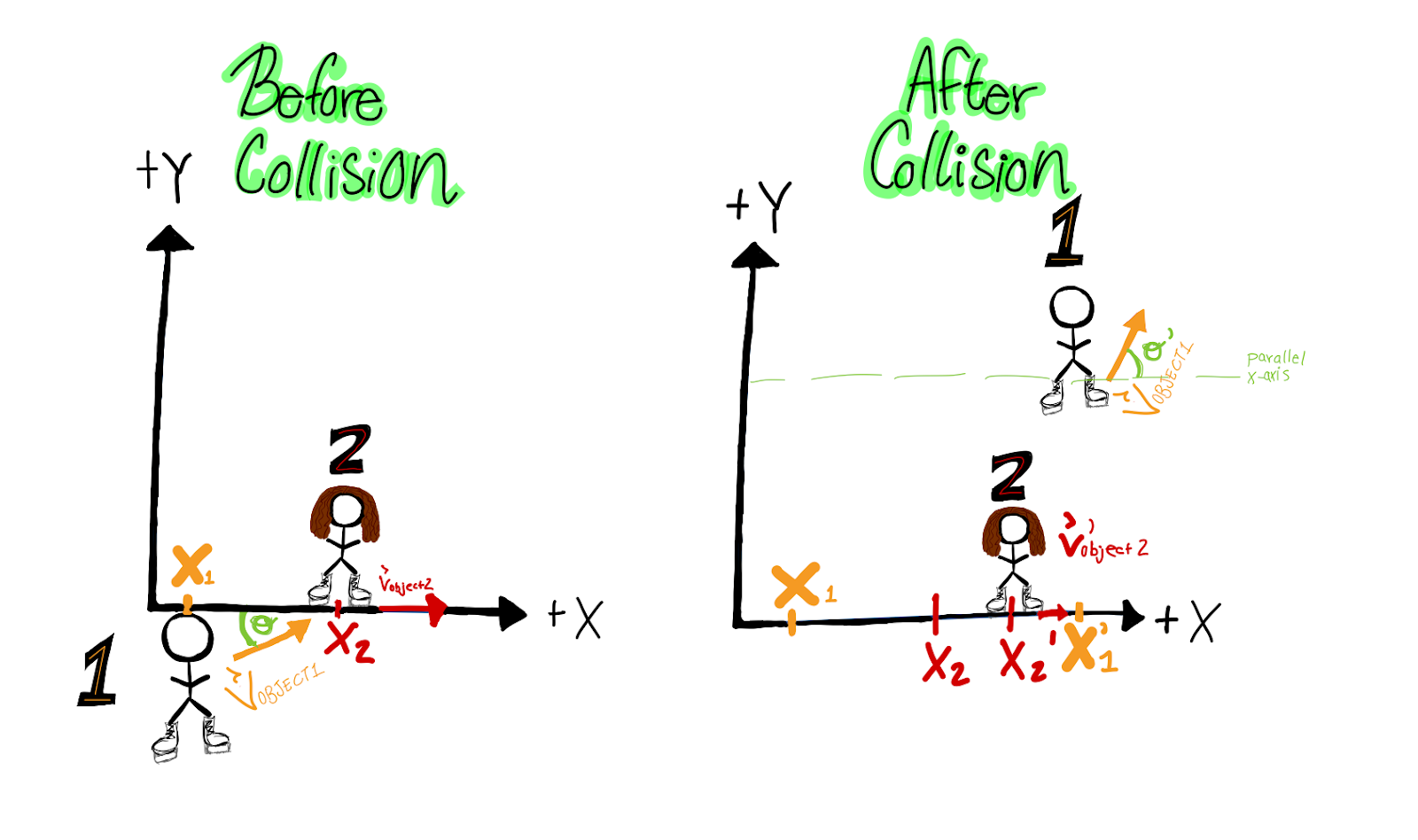
Although object #1 in the collision profusely apologized for skating into me while attempting to skate backwards without a rear view camera, I sincerely thanked object #1 for giving me a topic idea for my physics article on the relevance of physics in real life events. I plan to use this article to discuss how the skating collision relates to physics through the impulse and the conservation of momentum and energy, in addition to discussing the physics that makes ice skating possible. The collision began with I, object #2, skating at a very slow speed with my friend, who was dressed as a life-sized Hanukkah dreidel. Then, I felt something make contact with my back and push me forward slightly, watching as the other skater, object #1, moved at an angle away from me, at a decreased speed and angle of trajectory than I had initially seen them skating at. I am going to attempt to visually depict the event below. If the diagram is not adequate, please feel free to email me and we can recreate the scene at the next open skate event. I am not joking.
Summary of Collision Events
Before Collision
Object #1 initially moving at velocity greater than object #2.
Object #1 initial velocity direction was at an angle to the x-axis, assuming the axis is located in the direction of motion of object #2.
Object #2 initial velocity near 0 m/s in direction perpendicular to the y-axis, at a 0° angle overlaying the x-axis.
After Collision
Object #1 moved with a slightly decreased magnitude of velocity, at an angle greater than the initial angle of velocity.
Object #2 moved in the same angle as its initial velocity, with a magnitude of velocity greater than the initial.
Figure 1. Diagram of collision. Figure represents position and change in direction of velocity before and after collision event by the two skaters. The initial velocity of object #1, labeled above, is of greater magnitude than that of object #2, and decreases after collision. The initial magnitude of velocity of object #2 is low, but increases after collision with object #1. The x-axis is overlaid with the direction of velocity of object #2, while the direction of velocity of object 1 is represented by the orange velocity arrows, accompanied by a green indication of angle. Initial and final velocities and positions are represented by the labels, " v " and " v’ ", respectively, with object #1 being orange, and object #2 being red. My apologies if you are color blind. The same color scheme follows for position, as is indicated on the x-axis with initial position being “ x ” and final position being represented at “ x ‘ “.
Impulse and Conservation of Momentum
In an elastic collision, with no external forces applied, both energy and momentum are conserved as objects bounce off of each other. Our collision was likely elastic because we did not continue to move together at a new shared velocity after the collision, but object #1 was deflected away from me, object #2, because the initial velocity of object #1 was at an angle compared to my direction of velocity. I was pushed forward slightly due to the force applied to object #2 by object #1 upon impact. The inverse relationship between average force (FAvg) and change in time (Δt) can be seen in the formula for impact (I): I = FAvgΔt. Additionally, because we were ice skating, there is external force from friction interfering with the possibility of a perfectly elastic collision, but very little, as the coefficient of friction between ice skates and ice is between 0.006 and 0.016 (Lozowski et al., 2013). For comparison, a surface considered to be slip-resistant has a coefficient of friction ranging from 0.2 to 0.29 (Mohamed et al., 2011).
The force exerted on object #1 when colliding with object #2 was small enough to allow object #1 to continue motion at a different angle with only a magnitude of velocity slightly less than than object #1’s initial velocity. The small amount of force applied to object #2 during the collision was likely prolonged by the cushioning in the puffer jacket on object #1, and the hoodie on object #2, resulting in a decreased magnitude of force of impact in the collision (FAvg), due to an increase in change in time (Δt) during contact. In addition, the angle of approach of object 1 was altered because collision with object 2 interfered with the path of object 1.
Conservation of Energy
Object #1 initially had greater kinetic energy before the collision than they did after the collision. Some of their kinetic energy was transferred to object #2 upon collision, where it was absorbed by the cushioning of clothing, or transferred to object #2 as potential energy, and immediately translated into a short increase in the magnitude of object #2’s velocity, while object #1 experienced a slight decrease in magnitude of velocity. Non-conservative work would have a small value on the part of friction, as ice has a very low coefficient of friction, as mentioned earlier. It is likely that the mass of object #2 was greater than object #1 because of the minimal change in position experienced by object #2 as compared to object #1. However, the mass and speed of each object are unknown, so cannot be used to calculate KE or momentum at this time.
How Physics Allows For Ice Skating
Figure 2. Physics of ice skating. Figure originally published at (Physics of Ice Skating), https://www.real-world-physics-problems.com/physics-of-ice-skating.html. The figure presents the direction of the force vector as at an angle less than 90° to the direction of motion, although it is perpendicular to the direction the skate is facing. The angle of the skate from the direction of motion is represented by “a”, as this angle contributes to the acceleration that may be obtained, and the force vector is represented by “F”.
Ice has a low coefficient of friction in contact with ice skates because there is a layer of liquid water on top of the ice, which reduces the force of friction between the ice and the blade of the skate. In addition, the metal blade is a great conductor of heat, so that any friction that does result from skating generates heat which melts the ice into liquid, allowing for ease of skating. You can brake or speed up when ice skating due to the force applied from the edge of the blade on the ice in a perpendicular direction, allowing for the skater to push off of the ice and accelerate. Often, people skate with the hind leg pushing off of the ice to form enough friction to accelerate, and then switch to the other leg and do the same. Skaters have the option to increase the angle between the blade and where it is in perpendicular contact with the ice, providing even greater potential for acceleration (Physics of Ice Skating).
References
Cabot, M., & Davis, H. (2005). Ice Princess [Film]. Walt Disney Pictures.
Lozowski, E., Szilder, K., & Maw, S. (2013). A model of ice friction for a speed skate blade. Sports Engineering, 16(4), 239–253.
Mohamed, M.K. & Samy, Abdelhalim & Ali, W.Y. (2011). Friction Coefficient of Rubber Shoe Soles Sliding Against Ceramic Flooring. KGK Kautschuk Gummi Kunststoffe, 64, 44-49.
Physics of ice skating. Real World Physics Problems. From https://www.real-world-physics-problems.com/physics-of-ice-skating.html
If you have been living under a rock then you may not know that the World Cup is currently going on in Qatar right now. The World Cup is the most popular soccer tournament in the world where 32 of the best national teams compete to see who is the best, and it is held only once every 4 years. If you have watched any of these games lately you’ll notice a common trend. The sprinkler system in the field will always spray the field with water before warms-up, kick off, and during halftime. You may think this seems excessive to keeping the field healthy and you would be right, the sprinklers have no use on the health of the grass but instead on how the players like the game to be played. Any soccer player will tell you that a damp, not overly wet, field is the best to play on because of the speed that the ball travels across the grass. It’s fast, consistent, and keeps the spin that is applied to the pass across the ground. This makes for a better soccer game but how does the wet grass do this?

The answer is because the wet grass has less friction compared to dry grass, which can allow the ball to travel faster and do all these other things, but how is this possible from a basic physics level? So on a microscopic level, friction occurs because of irregularities between 2 materials. These irregularities can interlock with each other and cause a resistive force in the opposite direction of the object that is moving or having force applied to it. This is the basis of what causes friction force. When looking at a soccer ball on grass, there are irregularities in the ball and each individual grass it touches which slows the linear and centripetal velocities of the ball as it moves over them. Water, however, is liquid, and has no irregularities, so when it is on the grass/ball in small amounts it can fill in some of these irregularities and allow for less contact to occur. This means that the ball feels like friction force so the linear and centripetal velocities after it is kicked will decelerate at a low rate then if it was dry.